Executive Summary
Illinois currently charges a flat $151 annual registration fee for all passenger vehicles, regardless of weight. This analysis examines the potential for implementing a progressive weight-based fee structure similar to Washington D.C.'s successful 2023 program.
- Progressive Equity: A weight-based fee structure would shift costs to higher-income households who typically own heavier vehicles, while a majority of Illinois vehicles (≤4,000 lbs) would see minimal or no fee increases.
- Substantial Revenue Potential: Progressive fee schedules could generate an additional $500 million+ annually beyond current registration revenue, providing dedicated funding for driving alternatives like mass transit, transportation safety and infrastructure improvements.
- Implementation Feasibility: The system can be fully automated using existing VIN decoder databases, requiring no physical inspections or new hardware—following D.C.'s proven digital-first approach.
- Safety and Environmental Co-benefits: By creating price signals that discourage oversized vehicles, the policy could reduce traffic fatalities (which increase 47% per additional 1,000 lbs of vehicle weight) and carbon emissions.
This analysis recommends a moderate progressive schedule that:
- Maintains the current $151 fee for vehicles ≤3,000 lbs
- Gradually increases fees to $600 for vehicles ≥7,000 lbs
- Generates approximately $917 million in additional annual revenue
- Revenue is primarily generated by higher-income households with larger vehicles
Motivation
Illinois roads carry ever-larger vehicles whose mass and height raise the stakes of every crash. Over the last 30 years the average U.S. passenger vehicle has gained roughly 8 inches in height and 1,000 lb in curb weight (IIHS), while battery-electric models such as the GMC Hummer EV tip the scales at about 9,000 lb—nearly twice the weight of a Honda Civic.
These extra pounds and inches aren't just cosmetic:
- Crash lethality scales with size & mass – A National Bureau of Economic Research analysis finds that each additional 1,000 lb raises the odds a crash will kill someone by 47%.
- Blunt, high hoods amplify pedestrian danger – New research matching detailed crash data to vehicle dimensions shows that every 10 cm increase in front-end height ups pedestrian fatality risk by 22%, and that reducing the size could spare ≈ 500 American lives per year.
- Heavier vehicles are polluting vehicles – EPA's Automotive Trends 2022 report shows that a 5,500 lb 2021-model car emits ≈ 40% more CO₂ per mile than a sub-3,000 lb car. The IEA calculates that surging SUV sales (avg. curb weight ≈ 2t) drove >20% of the global growth in energy-related CO₂ in 2023.
Why a Weight-Based Registration Fee
Illinois already indexes fees for commercial and farm trucks to weight, but every passenger vehicle—from a 2,700 lb Honda Civic to a 9,000 lb truck—pays the same $151 annual tag (625 ILCS 5/3-806).
A sliding fee tied to curb weight should be considered for the following reasons:
- Internalize externalities – motorists of heavier vehicles would pay more for the risk they pose for deadly crashes, increased carbon emissions, and road damage.
- Nudge the market toward lighter, lower-risk models (and lower-emission powertrains).
- Fund safer alternatives – revenue can be earmarked for transit, walking, and cycling projects that reduce dependence on over-sized cars.
- It's a progressive tax – Heavier vehicles are largely purchased by higher-income households. And because car-free households (who skew lower-income) pay nothing at all, the fee's effective burden rises with the ability to pay.
- It's easy to administer – Fee collection is fully digital: the DMV decodes each VIN, pulls the manufacturer's shipping weight from NHTSA's VIN decoder database, and assigns the bracket. No weigh-ins or roadside stops required.
Weight-based fees are not new
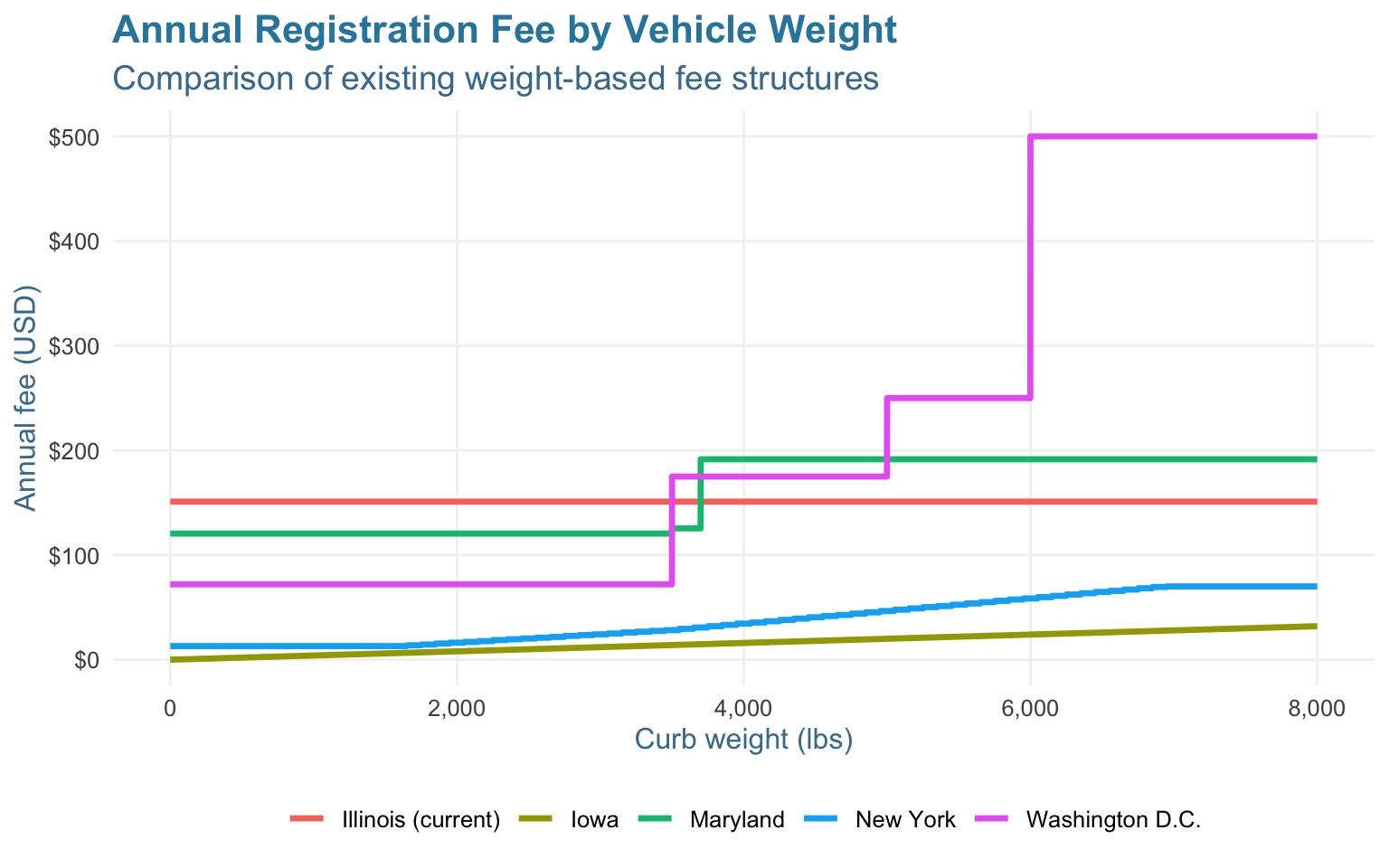
Over a dozen jurisdictions levy a progressive vehicle weight fee (USDOT). Washington D.C. has the most aggressive schedule, which was recently implemented in 2023. Here are a few of those fee schedules:
Case Study: How did Washington D.C. implement weight-based fees?
- 2019 – The first public draft of a weight-based registration fee appeared in the Vision Zero Enhancement Omnibus Act introduced by Councilmember Mary Cheh. Although the bill stalled, it seeded the concept that heavier cars should pay more because they pose outsized danger to people walking and biking.
- 2021 – D.C. DMV quietly tested the back-office plumbing with a one-year pilot that knocked $36 off renewals for cars under 3,500 lb, proving that curb-weight look-ups and automated billing could be done entirely inside the existing online renewal portal (no weigh-ins, no new hardware).
- June 2022 – The Council folded a refined four-tier schedule into the FY 2023 Budget Support Act. Annual fees now rise from $72 (<3,500 lb) to $500 (≥6,000 lb), plus a parallel set of higher rates for commercial vehicles. (Washington Post)
- Oct 2022 – Jan 2023 – DMV phased-in the new charges at renewal: most owners saw the higher bill that October, while the ≥6,000 lb tier took effect with the first 2023 registration cycle. An extra 1,000 lb "EV credit" was programmed to soften the hit on battery-electric models.
How the program works
- Automatic VIN decoding – Owners renew online or at a kiosk; the DMV pulls the manufacturer's shipping weight from NHTSA's VIN database and assigns the bracket in real time—no scales, no paperwork.
- Revenue & earmarks – The Chief Financial Officer forecast $2.1 million in the first partial year and $9 million per year once fully phased-in. Council language directs the money to sidewalk, school-zone safety and Vision Zero projects, linking the fee to the harms it is meant to offset.
- Equity guard-rails – <3,500 lb cars (about 48% of the fleet) saw no increase; heavier-vehicle owners—who on average have higher incomes—pay the surcharge. Critics argued the jump from $175 → $250 in the mid-weight tier could sting working families, but the Council's fiscal note found the median increase city-wide was $60/year (DC DMV).
- Complementary policies – The fee joins a suite of "blunt but simple" price signals—graduated residential parking permits, higher ticket fines for repeat scofflaws, and automated speed-camera expansions—meant to push the city toward its Vision Zero and climate goals (DC CFO).
Early lessons
- Earmark visibly – D.C. linked dollars from heavier vehicles directly to safety projects; polling shows that tying the fee to safer streets blunted opposition.
- Leverage existing data feeds – Because NHTSA's VIN decoder is already public, Illinois SOS could replicate D.C.'s fully digital workflow with minimal IT lift.
What could a weight-based fee look like in Illinois?
Illinois had 7,783,284 active passenger vehicle registrations as of May 30th 2025 (ILSOS), and all internal combustion vehicles pay a flat $151 tag. To see what a progressive schedule might raise, we need two things: (1) today's fleet weight mix and (2) a set of possible fee tables.
Fleet-weight distribution
EPA's 2024 Automotive Trends report publishes production shares by inertia-weight class (≈ curb-weight + 300 lb). Vehicles have become significantly heavier over the past 20 years.
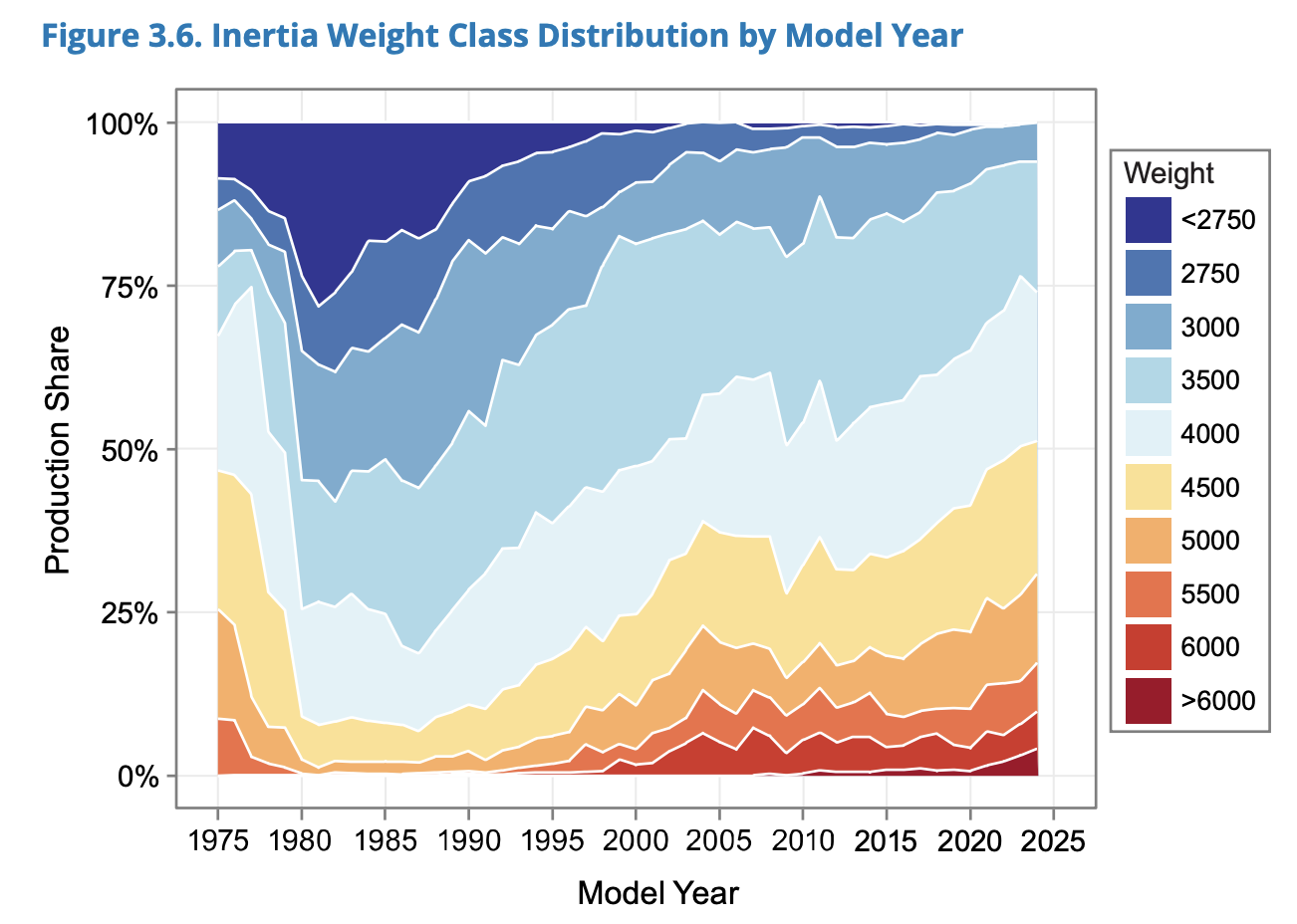
However, for this analysis we use actual VIN-based weight distribution data from New York State's DMV registration database rather than EPA production estimates. New York's fleet composition provides a more accurate proxy for Illinois than EPA production data because:
- Real-world fleet composition – NY data reflects the actual on-road fleet including older vehicles, not just new production
- VIN-decoded precision – Weight data comes from manufacturer specifications decoded from VIN numbers, not estimates
- Similar demographics – New York and Illinois have comparable income levels and urbanization patterns that influence vehicle choice
The New York DMV data shows vehicle distribution across 9 precise weight classes. We apply New York's weight class percentages to Illinois's total vehicle count to estimate the Illinois fleet distribution.
| Weight Range | Estimated Vehicles | Fleet Share |
|---|---|---|
| < 2,750 lb | 708,279 | 9% |
| 2,750–3,000 | 505,913 | 6% |
| 3,000–3,500 | 2,218,236 | 28% |
| 3,500–4,000 | 1,766,805 | 23% |
| 4,000–4,500 | 1,315,375 | 17% |
| 4,500–5,000 | 677,146 | 9% |
| 5,000–5,500 | 217,932 | 3% |
| 5,500–6,000 | 163,449 | 2% |
| ≥ 6,000 | 210,149 | 3% |
Based on New York State DMV VIN-decoded weight distribution applied to Illinois vehicle count. Actual Illinois fleet distribution may vary. ILSOS has access to VIN data for precise Illinois-specific analysis.
Modeling progressive fee schedules
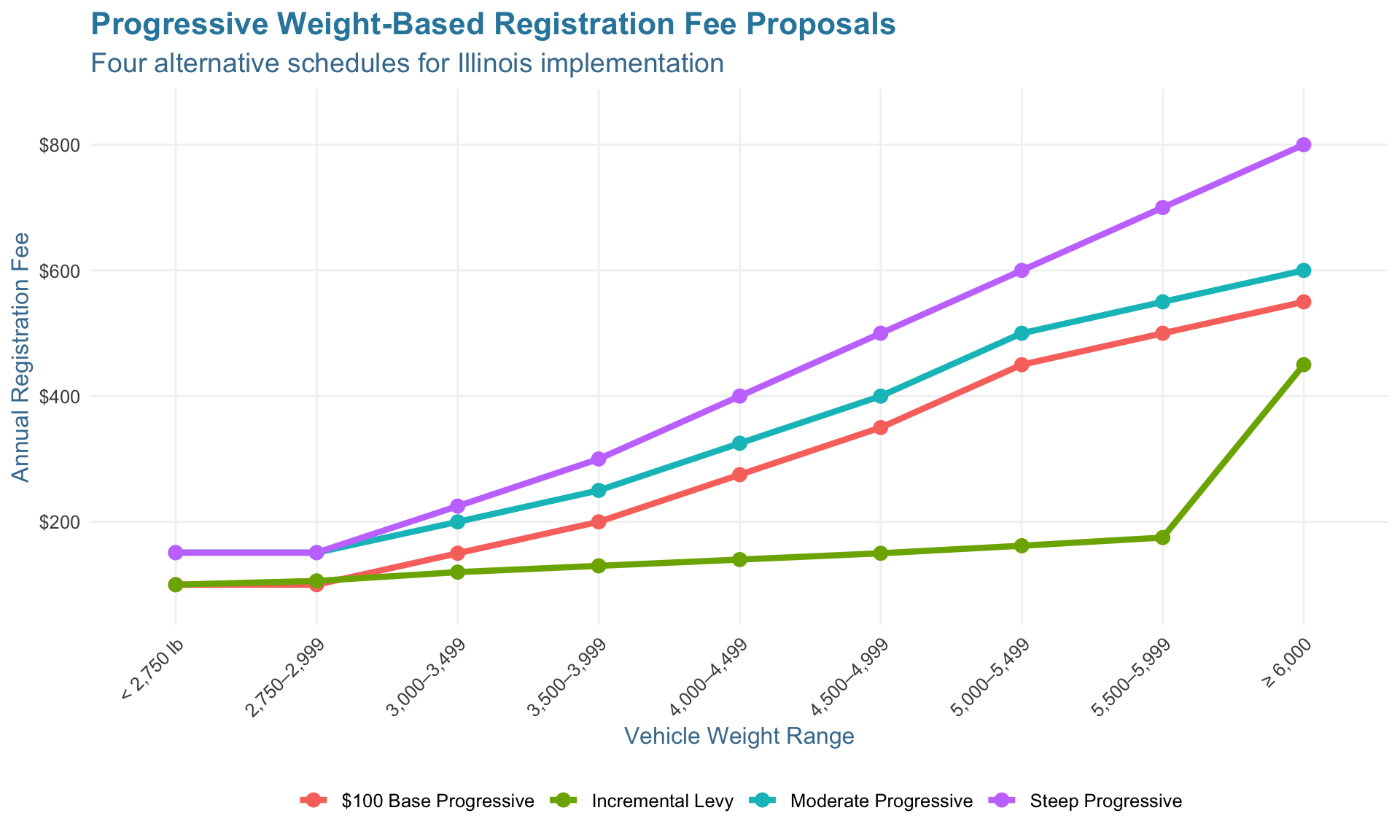
We model four different progressive fee approaches, each designed to address different policy priorities:
| Weight Range | Current | Moderate | Steep | $100 Base |
|---|---|---|---|---|
| < 2,750 lb | $151 | $151 | $151 | $100 |
| 2,750–3,000 | $151 | $151 | $151 | $100 |
| 3,000–3,500 | $151 | $200 | $225 | $150 |
| 3,500–4,000 | $151 | $250 | $300 | $170 |
| 4,000–4,500 | $151 | $325 | $400 | $200 |
| 4,500–5,000 | $151 | $400 | $500 | $215 |
| 5,000–5,500 | $151 | $500 | $600 | $230 |
| 5,500–6,000 | $151 | $550 | $700 | $245 |
| ≥ 6,000 | $151 | $600 | $800 | $300 |
All fees shown are annual amounts. $100 Base: Reduces base fee from $151 to $100 for lightest vehicles.
Revenue analysis
| Fee Structure | Total Annual Revenue | Est. Additional Revenue | % Increase |
|---|---|---|---|
| Current (Flat $151) | $1,175M | $0 | 0% |
| Moderate Progressive | $2,092M | $917M | +78.0% |
| Steep Progressive | $2,491M | $1,315M | +111.9% |
| $100 Base Progressive | $1,316M | $141M | +12.0% |
Based on 7,783,284 registered passenger vehicles in Illinois as of May 2025.
Progressive impact analysis
The weight-based fee structure creates a progressive tax system where higher-income households—who typically own heavier vehicles—bear a greater share of the burden:
| Weight Range | Vehicles | New Fee | Increase | Est. Additional Revenue |
|---|---|---|---|---|
| < 2,750 lb | 708,279 | $100 | −$51 | −$36.1M |
| 2,750–3,000 | 505,913 | $100 | −$51 | −$25.8M |
| 3,000–3,500 | 2,218,236 | $150 | −$1 | −$2.2M |
| 3,500–4,000 | 1,766,805 | $170 | +$19 | $33.6M |
| 4,000–4,500 | 1,315,375 | $200 | +$49 | $64.5M |
| 4,500–5,000 | 677,146 | $215 | +$64 | $43.3M |
| 5,000–5,500 | 217,932 | $230 | +$79 | $17.2M |
| 5,500–6,000 | 163,449 | $245 | +$94 | $15.4M |
| ≥ 6,000 | 210,149 | $300 | +$149 | $31.3M |
| Total | 7,783,284 | $141.2M |
Conclusion
The progressive nature of the fee structure creates a politically viable path forward. A majority of vehicle owners likely see minimal increases, and higher fees apply primarily to luxury vehicles. In order to be politically viable, revenue should directly fund popular safety and infrastructure improvements, and alternatives to driving like mass transit.
Next Steps
- This preliminary analysis is based on publicly-available data that is not as accurate as VIN data available to the Illinois Secretary of State. That office should explore the potential revenue forecasts using their private data about VIN shipping weight from the NHTSA VIN Decoder database.
- Automotive industry trade groups objected to this fee when it was introduced in Washington D.C. Their concerns should be heard and weighed against the status quo of damage caused by heavy large vehicles.
The path forward requires careful implementation to achieve the full potential of weight-based vehicle registration fees in Illinois. With proper execution, this policy can simultaneously advance equity, safety, environmental, and fiscal objectives while providing a model for other states to follow.